
In ‘A New Culture of Learning‘ the authors highlight how play is not only key to childhood but can be central to adults thriving in the twenty first century: and this is just one of a myriad arguments for a gamified approach to learning.
A sense of continuity and purpose to students’ work is a key feature of a gamified approach. One way I have tried doing this with my Year 9 groups was through an ongoing class project round the creation of a game of Trivial Pursuit.
Introduction to the project
At the start of the scholastic year students played a home-grown version of Trivial Pursuit that aimed to introduce Computing.
Flipped Classroom
This Presentation was made available online a week before the competition so that students/teams who wished to prepare for the class team-based competition had an opportunity of doing so. This presentation lent an element of discovery-learning to the exercise.

Two Rounds
As the Trivial Pursuit competition was divided into two rounds with a week’s break in between, teams that had not prepared for the first round had ample time to learn from their mistake and so look up the presentation and prepare better for the second round. This worked better as a motivator than I had hoped (perhaps partly as there were points for our year-long game ‘Save Silicon Valley’ riding on winning the game…as well as a box of chocolates). But I suppose the real reason is that most of us love a challenge.
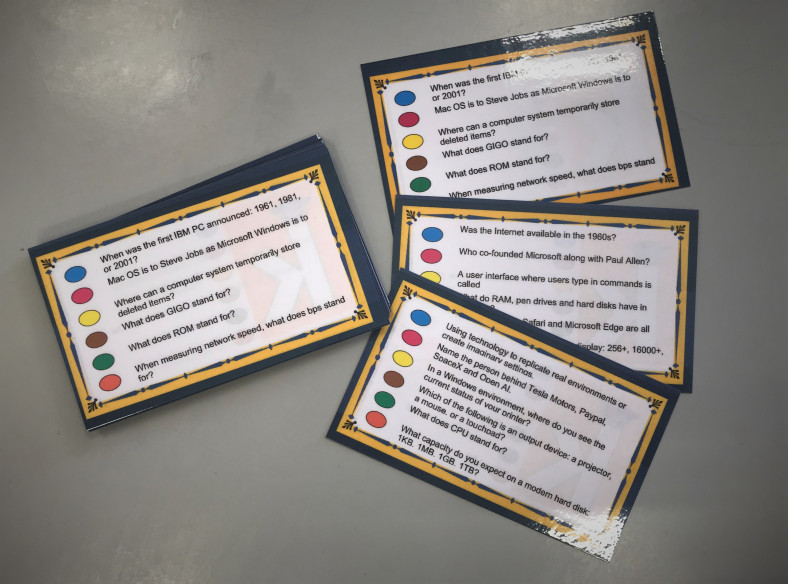
This Trivial Pursuit game (and the related presentation which students could access both at home and in class during the game itself) covered parts of our introductory unit, allowing self-learning of syllabus-content, a general introduction to Computing as well as background information about key personalities and companies featuring in our ‘Save Silicon Valley’ game.
This exercise went down very well with my students and helped set a very positive tone for the rest of our lessons.
A year-long project
Students were then to produce a similar Trivial Pursuit game in a year-long class-wide effort. At given points during the academic year, each student was given a Trivial Pursuit student question sheet and a section of the syllabus to produce questions about. Students had to come up with three questions: 2 about their section of syllabus content and one on generic topics related to Computing.
Project Conclusion
The questions students produced were to be pooled to create a Trivial Pursuit game that could be part of our revision exercise at the end of the scholastic year.
Students could also have a copy of the game to play at home or share with peers if they wish.
Critical Reflection
I think the idea was a good one, the execution of the year-long project far less so. Unfortunately many students did not bring in their questions and others did not bring them in on time. As a result, we never produced the students’ game.
Moving Forward
- I think I should set aside lesson time for students to create their three questions. It well-implemented, this can be a fruitful reflective exercise on our syllabus and should not be too time-consuming.
- I hope to implement this project idea again next time I teach a Year 9 group because I think it makes for an excellent way to introduce the subject and create a community feeling in the group, both through playing the initial game and in eventually creating their own revision game together.
 class4d21st.school.blog