
This exercise aims to increase the learning value of Half-Yearly Exams/tests etc, and is generally carried out in the first lesson after the exam/test session or as close to it as possible.
Part 1: Paper Review
Students are given a blog link with the marking scheme for the exam as well as a hardcopy exam-review document, linked below.
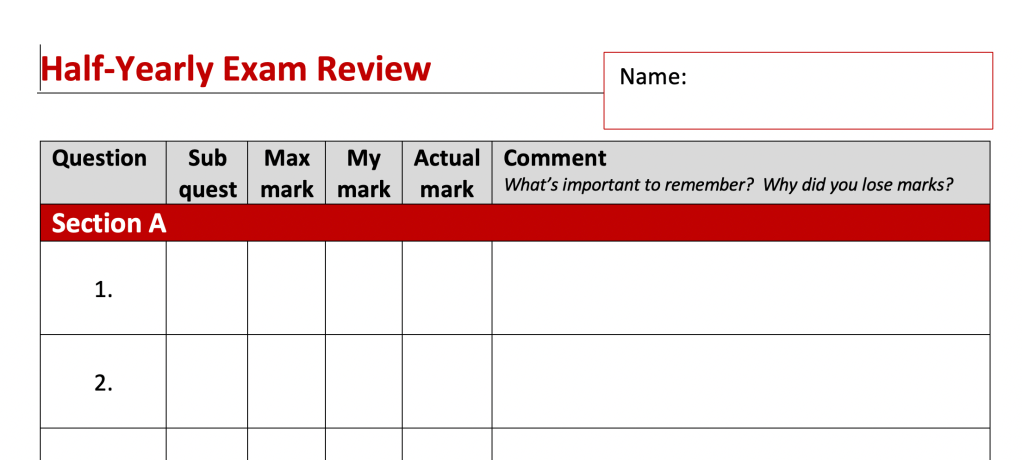
Hence students start by reviewing the paper and reflecingt on their performance to conclude how they think they did as per the table below. (At this point ‘Actual mark’ (the mark they actually obtained in the test/exam) is left empty)
Part 2: Actual Performance
Next students are given their own corrected paper and compare their actual performance to their perceived performance. At this point they note down the Actual Mark and then add comments regarding their performance in the last column (see above)
Part 3: General Review and Way Forward
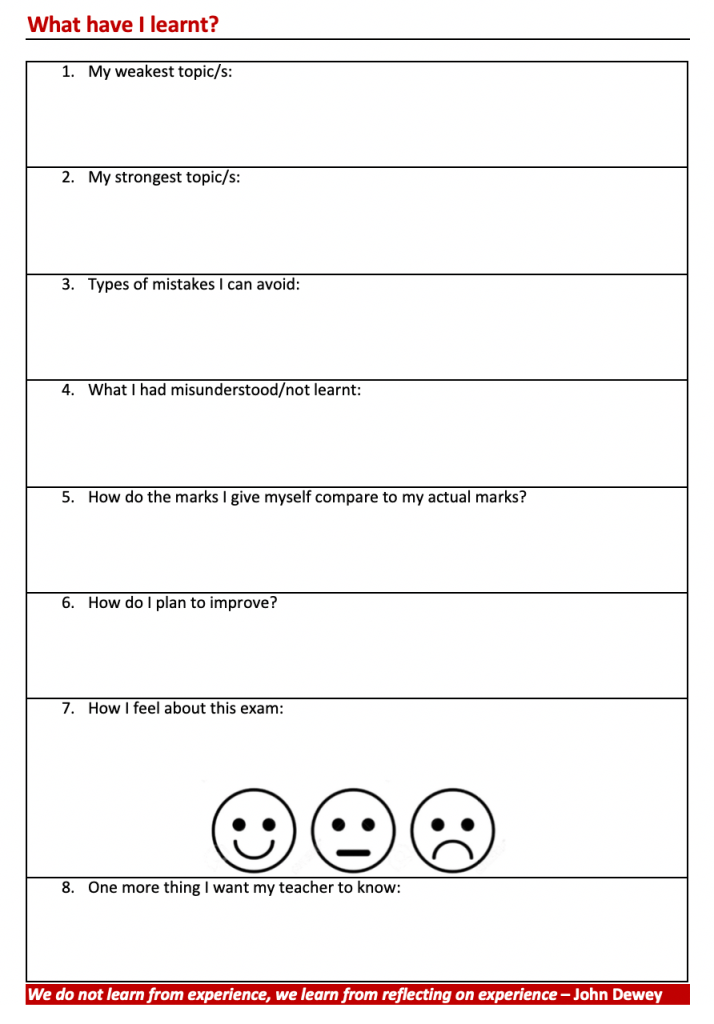
Next students reflect on their performance, prompted by the questions on the second page of the review sheet (shown below). Here they comment on their strengths and weaknesses and are then encouraged to reflect on their way forward.
Part 4: Teacher feedback
I then collect the review documents, taking note of the students’ comments and giving further feedback, encouraging them to explore their replies more deeply (E.g. ‘What do you mean by ‘study more’? Do you think you need to spend more time studying? Do you think you need to improve the quality of your study work?’).
Lastly I have a one-to-one discussion with each student, using this document as our fulcrum and together we draft a clearer way forward.
Critical Reflection
I am struck by the a-ha! moments my student experience during this exercise. Since their mark is not given outright, they focus on their performance more than the ‘number’ attached to it. Students look at where they lost marks and why, they kick themselves over marks carelessly lost and comment on the little things that made a difference to an answer. They also make quite spot-on remarks about their strenghts and weakness.
I think the questions on the second page encourages students to reflect deeper, however it was clear that they were not used to such reflection as many initially give very generic non-answers and need to be guided to deeper analysis.
When I first started out with this exercise, I did not include a one-to-one discussion with students at the end, but now that I’ve introduced it, I see great value in it. It encourages students to explore their strengths but also their fears and shortcomings with me and that helps us clarify our way foreward together and in the subject.
Moving Forward
Students comment very favourably on the usefulness of this exercise and I think I should seek to implement this structure more often and not limit myself to exams. Time, as always, remains a key factor though.
 class4d21st.school.blog