
Introduction
In a project that was loosely structured around the jigsaw technique, the Year 10 Computing Team used robotics and programming to explore the school’s annual exhibition theme of ‘The Verdala Experience’. We developed a timeline that invited visitors to a hands-on experience of our school’s rich history.
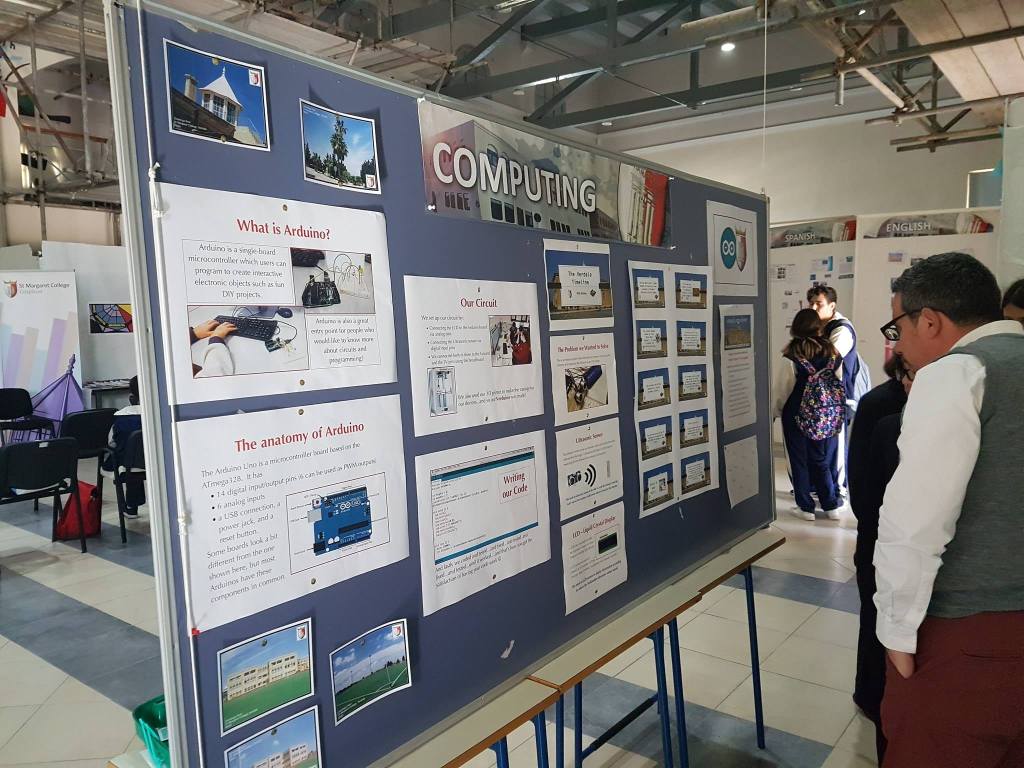
The team therefore created a robotic system that would invite visitors to participate by:
- Moving the robotic device, which students chose to call Verduino, along the timeline and reading the hint shown on the LCD screen.
- Using this hint, they could then place our school history cards in the correct order.
- Then, visitors could choose the correct sequence for the history cards on our presentation.
- The presentation checked if they got the pattern right and gave feedback accordingly.
Making Verduino
We made Verduino using Arduino and models created using our 3D printer.
We connected an ultrasonic sensor to Arduino so the system could read its position on the timeline. Then we wrote a program that according to the distance read would output a hint on an LCD screen that we also connected to the Arduino board.
We 3D-printed a ‘face’ for our ultrasonic sensor, a stand for Arduino and a frame for our LCD.
We called it Verduino: the first major Arduino project at Verdala!
We made the ‘school history’ cards showing key points in the story of our school and which we presented scrambled to visitors.
We used Microsoft Power point to create an interactive presentation that would tell participants whether they had the right history cards sequence.
A team effort!
Students brought different skills to the table and all had different roles:
- The Arduino team set up the circuit and programmed the device.
- Some students helped with the 3D-printing.
- The ‘game-makers’ researched the school history and created the game.
- Our presenters guided exhibition visitors through our game.
This project gave students the opportunity to develop a robotic system to solve a problem. Arduino gave students the flexibility to create a system that answered their needs and also gave their coding a physical angle. Since students are also learning Java and we used a variant of the C language to code Arduino, they could better reflect on essential similarities between programming languages and the centrality of certain coding principles to programming in general.
Students also had to identify the more suitable software to use to create their ‘game cards’ and interactive presentation.
Very importantly, this project showed students that it takes different skills and people to bring a project to fruition.
Critical Reflection
This was a very succesful team effort where students were empowered to bring their own ideas to the table and contribute through the project according to their ability. Students showed a great sense of belonging to the team effort and were proud and protective of it.
 class4d21st.school.blog